

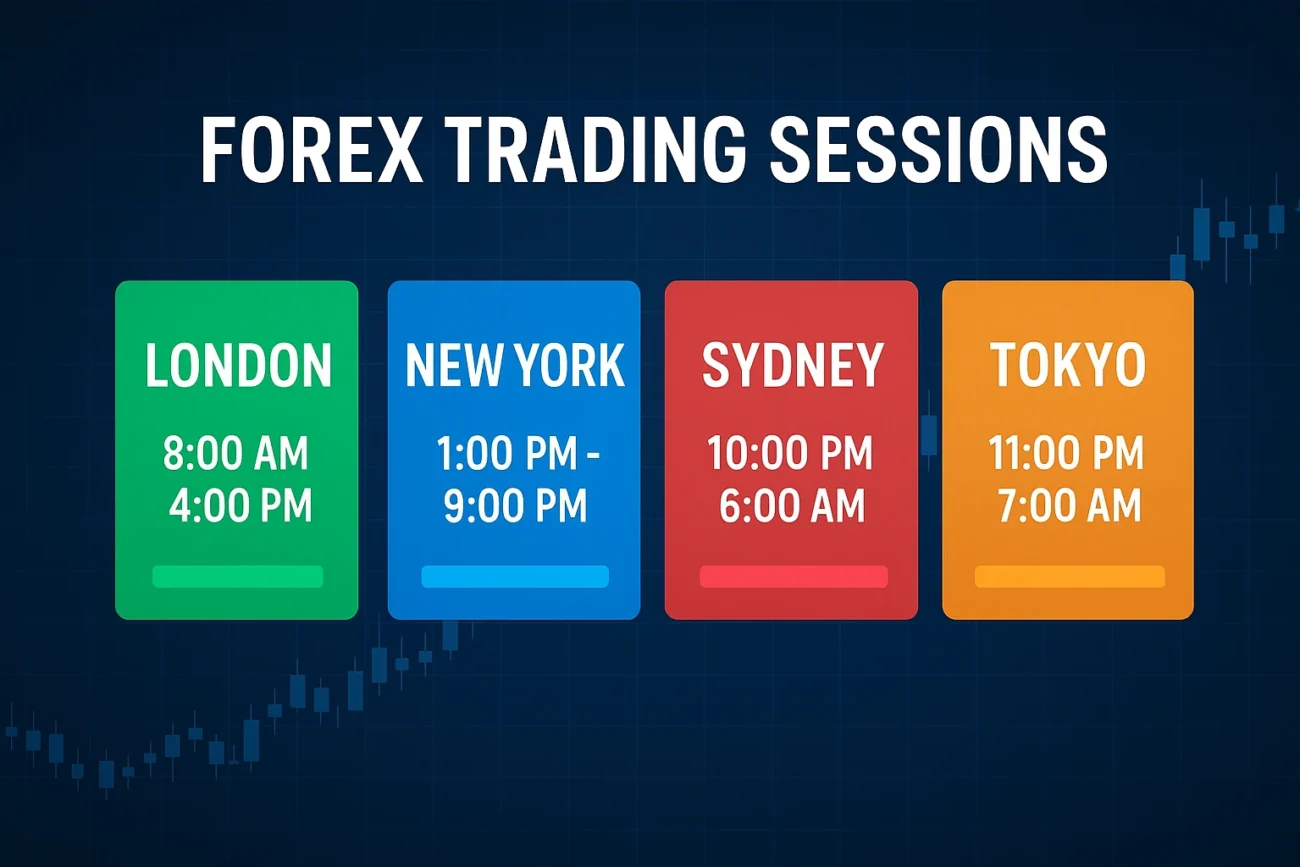
Learn the four major forex trading sessions , Forex Market Time Zone Converter – Sydney, Tokyo, London, and New York. Discover their timings, overlaps, and best hours to trade.
Forex Trading Sessions By Country – Real Time Market Hours
Forex Market Hours – Live Timeline & Sessions
| Market | Open Time | Close Time | Status |
|---|
Here’s a detailed breakdown of Forex trading sessions, including their high and low volatility times, and the best hours to trade based on liquidity and price movement:
In Forex and financial markets, trading sessions refer to specific periods during the day when a particular financial market or exchange is open for trading. Since Forex operates 24 hours a day, it is divided into multiple sessions based on major financial centers around the world. Each session has its own characteristics, trading volume, and market activity.
The main trading sessions are:
- Tokyo Session (Asian Session) – Active when Asian markets, especially Japan, are open. Generally quieter than European and U.S. sessions.
- London Session (European Session) – High liquidity and volatility, overlaps with Tokyo early in the day and with New York later.
- New York Session (U.S. Session) – Significant market activity; overlaps with London session, often causing the highest volatility.
Key points about trading sessions:
- They indicate when traders are most active in certain markets.
- Volatility, price movements, and liquidity vary depending on the session.
- Overlaps between sessions (e.g., London–New York) are usually the most active trading periods.
Trading sessions have a direct impact on liquidity and volatility in financial markets, especially in Forex. Here’s a clear breakdown:
1. Liquidity
Liquidity refers to how easily an asset can be bought or sold without significantly affecting its price.
- High liquidity: Many traders are active, so orders can be executed quickly at stable prices.
- Low liquidity: Fewer traders are active, leading to wider spreads and slower order execution.
Impact of sessions on liquidity:
- Tokyo (Asian) session: Moderate liquidity; mainly JPY, AUD, and NZD pairs are active.
- London (European) session: High liquidity; major pairs like EUR/USD, GBP/USD, and USD/JPY see strong activity.
- New York (U.S.) session: High liquidity; USD-based pairs dominate.
- Session overlaps: London–New York overlap has the highest liquidity, because traders from both major markets are active simultaneously.
2. Volatility
Volatility refers to the speed and magnitude of price movements.
Impact of sessions on volatility:
- Tokyo session: Lower volatility for many pairs; some JPY crosses may move more.
- London session: Higher volatility; large price swings occur as European markets react to news and orders flow in.
- New York session: High volatility continues, especially when overlapping with London.
- Session overlaps: Most volatile times; markets react to both U.S. and European economic data simultaneously.
TIMMING OF FOREX
The Forex market is open 24 hours a day, 5 days a week, and is divided into four main sessions:
🔄 Session Overlaps = High Volatility
The most active and volatile periods happen during session overlaps, when two markets are open simultaneously:
✅ London + New York Overlap
- Time (UTC): 1:00 PM – 5:00 PM
- Volatility: 🔥 Very High
- Best Pairs: EUR/USD, GBP/USD, USD/CHF
- Reason: Two largest markets trading simultaneously; high news impact.
✅ Tokyo + London Overlap
- Time (UTC): 8:00 AM – 9:00 AM
- Volatility: 🔺 Moderate
- Pairs Affected: EUR/JPY, GBP/JPY
- Reason: Brief overlap, usually early volatility spike.
🕒 Best Times to Trade (High Volatility)
| 6:00 AM – 9:00 AM | Rising Volatility | GBP/JPY, EUR/USD |
| 1:00 PM – 4:00 PM | Peak Volatility | EUR/USD, GBP/USD, USD/JPY |
| 2:00 AM – 5:00 AM | Moderate | AUD/USD, USD/JPY |
💡 Tips:
- Avoid trading during illiquid hours (e.g., late NY to early Sydney).
- Focus on session overlaps for maximum momentum.
- Align trading with economic news releases in the session’s local currency.
More services By FX WITH AKS
